|
Nevada Outlook
Spring 2007
Tight & Tighter
Strong Nevada job creation of the past four years has contributed to one of the tightest labor markets ever experienced in the state. The Nevada unemployment rate averaged 4.2% in both 2005 and 2006, the lowest average annual rates in more than 30 years. By comparison, the state’s jobless rate averaged 5.1% between 2000 and 2005 and averaged 5.5% during the decade of the 1990s.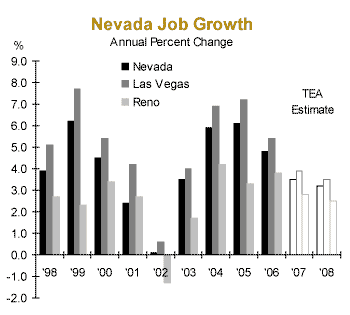
An average Las Vegas jobless rate of 4.0% in both 2005 and 2006 also ranks with the lowest ever recorded, while Reno’s 3.9% average jobless rate in 2006 was the lowest in six years. Such tight labor availability has occurred despite the solid flow of new residents to the state in recent years.
The Nevada economy continues to rank as one of the nation’s top five states as measured by percentage gain in total employment. Nevada added an estimated 58,500 net new jobs in 2006, a powerful 4.8% growth rate. Net job gains have occurred in nearly all employment sectors.
As is typically the case, the Las Vegas metropolitan area added roughly 80% of the net new jobs created in the state over the past four years. The Reno-Sparks metro area accounted for roughly 12% of net new jobs.
Regional Strength
Strong Nevada employment growth is consistent with that of its neighbors, where Arizona, Idaho, and Utah also rank among the nation’s top five job growth states. California and Oregon rank among the top 20 job growth states (see chart). 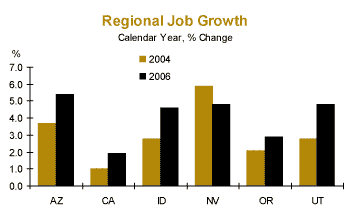
Many Nevada companies note their frustrations in filling open positions and pressures in retaining key employees. Such concerns are most prominent in the small business sector, where many firms cannot offer wage levels and benefit packages to match those of larger employers. However, those firms willing to pay higher wages, as well as firms that enjoy solid reputations as employers, are having many fewer labor availability challenges.
Too Far…Too Fast
Nevada’s residential real estate market has been on quite a roller coaster ride in recent years. The state’s residential real estate values were routinely ranked among the nation’s strongest gainers in 2002 to 2005.
However, Nevada’s average home price appreciation of 3.95% during 2006 ranked 40th in the nation. Utah led the states with an average rise of 17.55% in 2006 after ranking dead last in 2003. By comparison, the average U.S. home value rose 5.87% during 2006, with dozens of housing markets around the nation seeing modest price declines.
The source of the data, the Office of Federal Housing Enterprise Oversight (OFHEO), is considered an accurate indicator of home prices. The data measures repeat sales and refinancings of millions of existing homes since 1975 in more than 375 communities.
While many homeowners and the media focus on the latest 12-month data, a five-year measure of price changes is also of value. The average American home price rose 55.21% between 2001 and 2006. By comparison, the average Nevada home price rose 99.35%, suggesting homeowners and investors pushed prices too high.
The average Las Vegas-Paradise home value rose 5.36% during 2006, while the five-year price rise was a steamy 102.61%. The average Reno home value dipped 0.84%, while the five-year rise was 96.03%. Carson City home values recorded one-year and five-year changes of -0.48% and 93.47%, respectively.
Another major measure of home values provided by the National Association of Realtors noted the median U.S. home value (half cost less, half cost more) declined 2.7% to $219,300 in 2006. The study noted the median Las Vegas-Paradise home value dipped 0.8% to $313,500, while the median Reno home value fell by 8.9% to $332,900.
Nevada home values are likely to move sideways if not slightly lower over the balance of 2007 and into 2008. A housing bubble? It appears to be deflating on both coasts and across the Southwest (see pages 3-4 for more housing detail). The state’s commercial real estate sector continues to do well.
Nevada View
The state’s employers are dealing with the tightest labor market in decades, a particular challenge for smaller employers. The Nevada residential real estate sector is struggling with prior price gains that may be difficult to sustain. On balance, however, the Nevada economy continues to rank with the best in the nation, a position likely to be maintained over the next 18 months.
|