|
U.S. Outlook
Winter 2012
The U.S. Economy
What we now call the Great Recession officially began in December 2007 and ended in June 2009. It was the longest, the deepest, and the most painful recession since the Great Depression.
By my count, that suggests that the current U.S. economic expansion has now reached the two-and-a-half year mark. The current expansion has been less than satisfying both statistically and emotionally, with major headwinds still in play involving weak residential and commercial real estate markets, uncomfortably high unemployment, major European financial risk, and elevated levels of anxiety about the direction of the federal government.
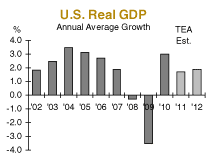 The current U.S. economic expansion has been especially lackluster when considering the massive and unprecedented levels of both fiscal and monetary stimulus. While modest economic growth has returned, a “recession of confidence” remains center stage. The current U.S. economic expansion has been especially lackluster when considering the massive and unprecedented levels of both fiscal and monetary stimulus. While modest economic growth has returned, a “recession of confidence” remains center stage.
Economic growth in 2012 is likely to remain substandard, with most forecasts congregating around a 1.5%-2.5% real (inflation adjusted) rate of growth. More bearish forecasters see particularly anemic growth in 2012’s first half.
The size and scope of a possible European financial implosion could lead the U.S. and much of the world back into recession, although that is not the consensus view. Nevertheless, investors around the globe have taken a “shoot first, ask questions later” approach to European sovereign (national) debt markets and the contagion that has now spread to more and more members of the euro community.
Government
Political theater of the absurd has been commonplace in the nation’s capital, with extreme partisan politics today’s reality. The government’s ability to live within its means remains highly elusive, even as European developments should be sending strong signals to Washington DC about damaging annual budget deficits and a more than $15,000,000,000,000 gross national debt.
Various economic studies have suggested that any nation’s ability to prosper and grow at a satisfactory pace is endangered when its gross national debt reaches 90% of that nation’s annual economic output. We are now at 100%...and rising quickly.
Trillion dollar plus budget deficits of the past three fiscal years will continue for as far as the eye can see. The biggest threat to this nation is the financial cancer of irresponsible government deficits. The need to slow the future growth pace of entitlement programs is mandatory.
 U.S. Employment U.S. Employment
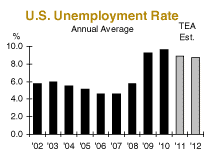
Wary business leaders and worried consumers have contributed to the weak level of American job creation during the current economic recovery. The nation has regained less than one-third of the eight million jobs lost during the crisis of 2008 and 2009. Unless and until confidence levels improve, weak additions to employment will continue.
The nation’s unemployment rate has averaged 9.0% for the past three years. Most forecasters see an unemployment rate of not less than 8.5% by the end of 2012.
To be heard frequently during the Presidential campaign now well underway…no sitting President in the past 75 years has been rewarded with a second term when the unemployment rate was above 7.2%. Whether the President can shift the blame for high unemployment to Republicans in the Congress will have a telling impact on election results.
U.S. Inflation
Consumer prices are expected to rise roughly 3.5% during 2011, with a slightly lesser rise being the consensus view for 2012. Weak global economic growth could lead oil prices lower, a key element in that forecast. Over a longer time horizon, the debate continues between those expecting higher U.S. inflation and those seeing a 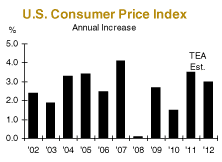 Japan-style deflation in the U.S. Japan-style deflation in the U.S.
The Federal Reserve
The Fed’s most critical interest rate—the federal funds rate—has been at an all-time low target level of 0.00%-0.25% since December 2008. Moreover, the Fed’s Open Market Committee has stated it expects this rate to remain unchanged until at least mid-2013.
In addition, the Fed has tripled the size of its balance sheet by buying massive amounts of U.S. Treasury securities and mortgage-backed securities. The intent? To drive long-term interest rates lower. While such actions have been largely successful, weak home prices across the nation, high unemployment, and a more paper-intensive lending industry…negatively impacted by the Dodd-Frank financial legislation…has not led to a strong surge in mortgage refinance activity.
Housing AND Rates
Most forecasting economists see national home prices stabilizing by mid-year 2012, with very modest price appreciation to follow. At the same time, conventional 30-year fixed-rate mortgages have been at a 60-year low near 4.0% in recent weeks.
One could make a case to delay a home purchase for 6-12 months, but mortgage rates could rise enough to offset any slightly lower home price. Now may be an outstanding time to purchase a new or foreclosed property and to refinance a mortgage.
Global Keys
Chinese and Indian economic growth are likely to slow somewhat, while Japan struggles with very substandard performance. High oil prices have boosted oil producing nations at the expense of user nations. The Canadian economy has slowed, while Mexico and Brazil are doing well.
However, these days it’s all about a fragile European economy. Greece, Ireland, and Portugal have already been bailed out, while major anxiety about Spain and Italy exists. Even the French have seen borrowing costs rise as questions about that economy have surfaced.
The Germans and the International Monetary Fund will face rising pressure to stem European debt contagion, even as impacted nations face the real need to get spending and debt issuance under control. No other issue is more critical to global economic performance in 2012 than a solid resolution of the European debt crisis.
|